
I’m a little bit late to the party on this one, but there was a bit of an online kerfuffle the other week about the idea of ‘authors don’t need to read to write’. It’s a topic that crops up pretty regularly—by the time you read this, it might have popped up again—and has done since the dawn of the novel itself. Edward Young, in “Conjectures on Original Composition“, argued that there are ‘Originals’ and ‘Imitators’, and that reading too much would lead a person to become an imitator (whose ‘debt is at least equal to his glory’).
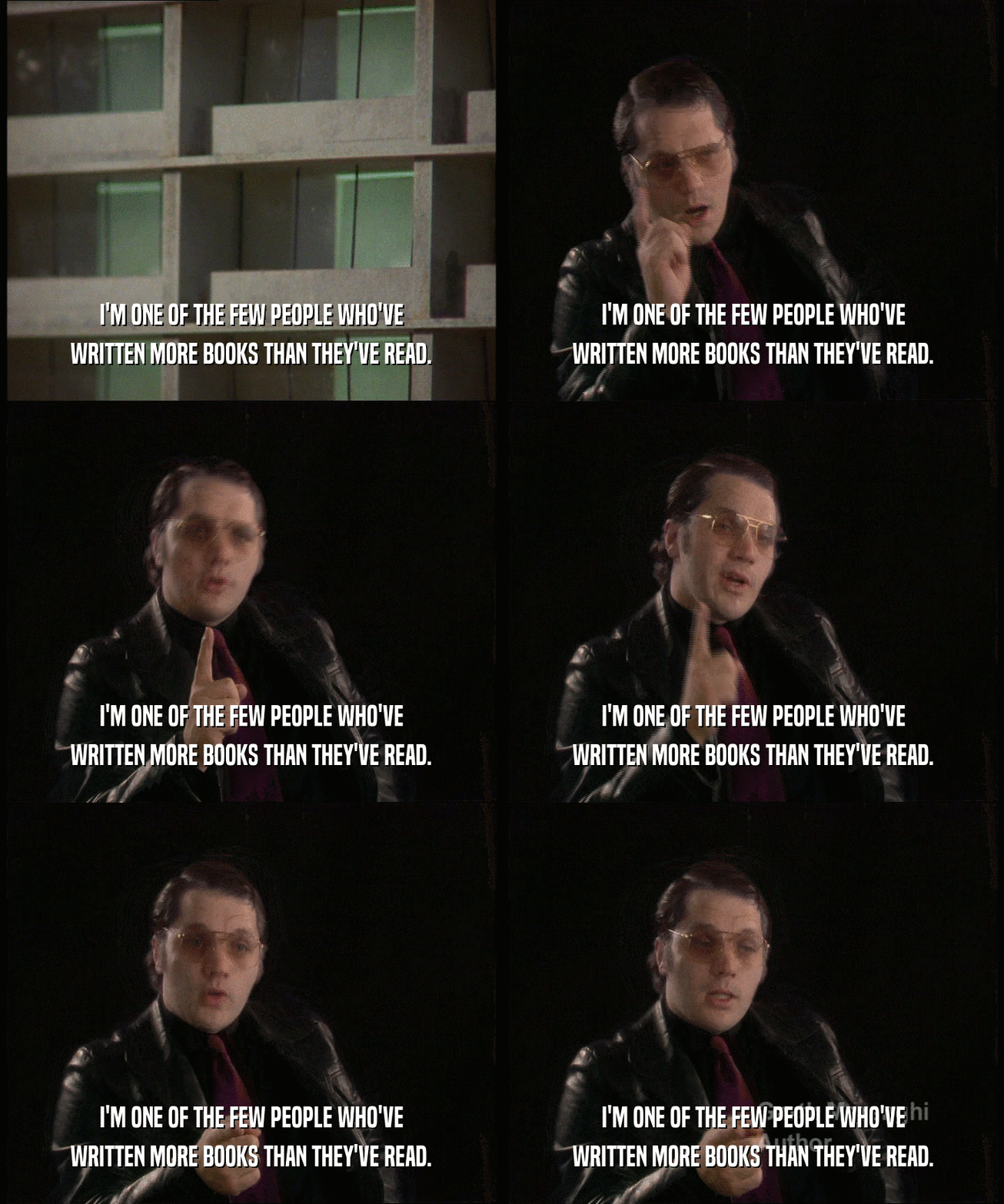
I am, of course, a rampant imitator. I wrote a Thing-like, a Predator-like and a Robot Inspector Poirot short story pair. The Predator-like is probably the most galling—it is literally constructed to imitate the first Predator film at a skeletal level, a purposeful exercise as I had intended on using the action film as a deconstruction of power dynamics.
The others are simply allusions, and they are allusions I could not have made without having previously read Christie or Campbell.
People chalk this argument—that writers needn’t read—up to all kinds of things. It’s amusing seeing people assign blame to ‘lowered attention spams’ or ‘doomscrolling’ when Edward Young was peddling this stuff back in 1759. People say it’s laziness, or anti-intellectualism, but I don’t think it’s all that deep.
The truth is reading can be hard and writing can feel very easy by comparison. I have edited far more than I have written, over the years, not least because I have often edited my own work. And once you learn to read with a critical, editor’s eye, you can never unsee things. It’s that Baader-Meinhoff effect where once you are made aware of something, you notice it everywhere—imagine that every time you read text. I find myself wincing at errant typos in advertising copy, and I’m trying my best to not read that.
That’s what I think a lot of the people scoffing at non-readers don’t understand. It’s easy to think of reading as fun. To reminisce on the days of hiding under your bedsheet, reading borrowed Goosebumps books by flashlight so your parents don’t know you’ve stayed up past your bedtime. But If you’re reading to improve your craft at writing, you have to be reading with a critical eye. You don’t have to edit your current book du jour, but it’s not like you can slack-jawed absorb a text without expelling any energy at all. If the purpose of reading is to become a better writer—and that is the counter-thesis at the core of the entire affair—then reading must become work.
And that work feels even harder when you’re reading something you don’t like. It might actually be bad, but more often it might just be something that isn’t for you. I’m 42 years old. I know what kinds of books I like. I’m still frequently surprised by books I think I’ll like and don’t—and vice versa—but I can tell pretty quickly these days when I’m not going to like a book very much. And when I’m five pages into a book that has repeated its central thesis three times in increasingly flowery prose, I know I’m in for a hard day in the word mines.
By comparison, writing feels very easy. Especially when you’re writing from your heart. Free-flow creating is a joyous expression of humanity. It is a celebration of where we’ve come as people. The fact that even I, who grew up (relative to my surroundings) poor, can afford to expend free time imagining things and putting them to (digital) paper is literally something my ancestors must have dreamed of while they scrabbled to find their next meal.
Writing is so, so easy. And it’s even easier when you don’t give a shit about the output—which you wouldn’t, if you refused to read anything written by other people and therefore had no benchmark against which to measure yourself.
That’s right, I’m on the side of writers need to read. Of course they do. Reading is a joyous thing too, even if it can be harder than writing. I’ll freely admit that I go through cycles of reading very little, but I still read basically everyday. Sometimes it’s non-fiction—I don’t think that’s a problem. Compelling non-fiction is still written with a storyteller’s eye, and I’ve written before about how I think researching is one of my favourite things to do when writing, so of course non-fiction counts.
Even when it’s a bad book, or just a book that’s not for me, I’ll still endeavour to read it (although I did bail out on one recently). As Alan Moore says in his BBC Maestro Storytelling Course, “read terrible books”.
It’s interesting, because he echoes the argument of Edward Young in his advice there, saying there is a danger of plagiarising good work (something you don’t need to worry about with shit books)—I don’t think he means this sincerely. Hell, I don’t take the part about using bad writing as a confidence boost at face value either—I think he’s just trying to share a great piece of advice (read more) in an entertaining and evocative way. Almost like he’s some sort of accomplished storyteller.
On the subject of reading bad books, I’ve been reading a lot more. I’ve read some comics—I enjoyed the recent “Event Horizon” series for how they approached what I consider a fairly impossible task. I’ve read some short stories—I revisited Jorges Luis Borges after an encounter with Steven L. Peck’s “A Short Stay In Hell” (which for my money seemed to end almost out of nowhere). I’ve read a few novels, finishing Joe Abercrombie’s The First Law trilogy finally, a bleak series with an even bleaker ending than I anticipated (although it’s very good). I read Eight Seasons, by my friend D.L. Ward, which is part travelogue part heartbreak set in South Korea at the turn of the Century. I read Our Share of Night by Mariana Enriquez (translated by Megan McDowell), which honestly took some work—it’s overly descriptive to a mind-numbing degree, which is a bit of a shame because when it’s hitting, it’s hitting hard. I won’t name the book I did not finish, as it doesn’t seem right. Also it’s very popular and people will be mad at me.
What I’ve done is I’ve rejigged my evenings so that I read before bed, and it’s been quite good for falling asleep. The books aren’t boring, but my heart rate is able to lower better, and so I’m able to drift off faster. I’ve been reading on my ereader, a Kobo Libra Colour, and it’s pretty good. I’ve been reading actual real books too, though I find them generally more annoying. There is something compelling about the feel of paper in the hand though.
Speaking of the Kobo, my books are now available on the Kobo Store! You can buy them there, if you like, instead of just via Amazon or this website. I’ve also removed the DRM elements from the copies on Amazon—removing that has only recently become an option, although I’ve been selling DRM free versions since day dot.
On to a writing update! The first book in my new series is with readers now! It is a very vulnerable thing, sharing your work with people. It has been a source of immense stress in my life. I think it’s probably something non-artists will never understand, because a part of yourself goes into every piece, and now that part is away from me.
The feedback I’ve gotten so far has been good though. That’s very nice. There is a little bit of work to do on Final Final Girl before I publish it, but I am confident it will be out very soon. Progress on book two in the series is coming along nicely too. After I publish FFG, I will break down what took me so long to finish it. It’s more involved than you might think, but solving the problem I ran into is quite informative I think.
 Joabyjojo
Leave a comment