
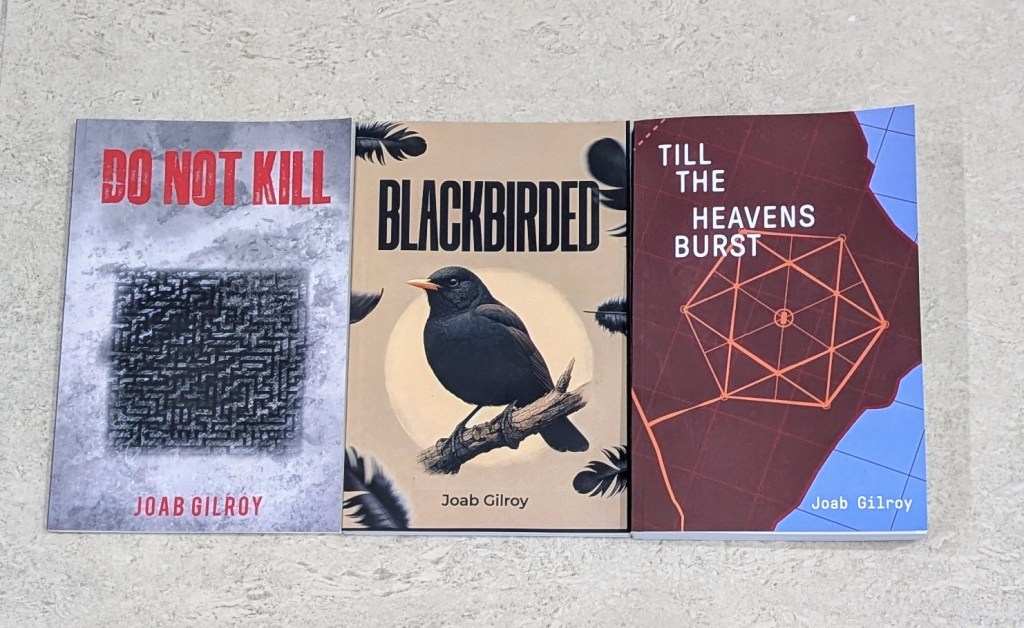
Last month I released a book, Till The Heavens Burst. I’m very proud of that book, I think it’s great, and I wrote it the only way I know how—I wrote something I want to read. I wrote it in a manner that I would like to read it. It’s not filled with prose, it’s deliberately vague, it’s deliberately wrong, it’s misleading and it’s only about a tenth of the actual story. Maybe it’s a little too much of all those things. I’m a very skilled writer, but maybe I’m not a very skilled fiction writer yet, and so maybe I bit off more than I could chew with TTHB.
But I wouldn’t really know that, not yet. Outside of my editor, my beta readers and one very special fan I haven’t gotten any feedback on the book yet. I have no way of knowing how it went.
This isn’t a plea for attention or some ‘woe is me’ tale. I’m just trying to be sincere, as I always am on this blog. I’m an open book here, because I’m pretty sure the few people who read this have already heard me say this shit outloud, and if they haven’t they’ll hear it soon anyway. So it’s not a ‘boohoo nobody gave me feedback’ thing. I’d love it, of course, but I get why. I wanted to break down exactly why I think it hasn’t happened.
I’ve been a professional games critic for 17 years now. I’ve been good at it—really, really fucking good at it—for about 15 of them. And the reason I’m good at it is because I understand there’s only one thing that actually matters in a game review: absolute honesty. You can say whatever you want, as long as it’s built on a foundation of honesty. The moment a review strays from that foundation is when it begins to crumble.
Fluid, entertaining writing is obviously helpful, and knowing how to edit your own work is good when you’re in an industry that keeps shrinking. And having the vocabulary to explain why you arrived at your honest conclusions is fundamental to writing illuminating copy.
But honesty is the key factor. And sometimes that honesty can be scary. It can be hurtful. It can mean admitting to your own faults. There were games I played that I found myself despising, until I realised I’d made some fundamental error in my understanding of the game itself. I had to cop to that, and I had to rectify the situation as best I could. Recently I’ve had to confront the fact that more and more games just aren’t designed with me in mind. I’ve nearly aged out of what triple A games are trying to achieve, even if my passion for the hobby hasn’t.
You have to be honest with the creative. And if you know the creative involved, that can be tricky. You don’t want to hurt feelings, right? You don’t want to ‘yuck someone’s yum’. If you live your life always trying to do your best, it’s easy to assume other people do the same—and you don’t want to look a friend dead in the eye and tell them their best wasn’t enough.
But here’s the thing. What I learned two years into my career as a games critic (among many other things) was that the greatest respect you can pay a creative is honest feedback. Even if it’s negative, honest feedback is a glorious thing to a creative person. Sure, it says “your best wasn’t enough this time”, but that’s not the end of it. Because it also says “I believe you are capable of more”. It says “you fell short of your potential”, but also “I think you have great potential”.
You tell children they did a good job when they hand you some scribbled drawing that you stick to the fridge. You tell a dog he’s a good boy when he drops an unsolicited stick in front of you. You don’t give them honest feedback because you don’t expect anything more of these beings. They have met or exceeded their potential in your eyes, and that’s a beautiful thing. It is a great thing, trying your best, and it is in all our interests to imbue children and dogs with that ideal.
But in a professional setting that concept goes out the window. I’m reminded of a phrase I am fond of, my critic mantra.
Trying and failing is still failing.
Failure is a terrifying thing for a lot of people. I blame popular media, which I do for a lot of things. I’m old, remember. “Failure will not be tolerated” is a common refrain from bad-ass characters in stories like Star Wars, James Bond and The Hunger Games. It’s catchy, a brainworm phrase that seeps in at a young age and does irrevocable damage.
In Till The Heavens Burst, Xander Cosway is afraid of failure to the point of paralysis. He has self-contextualised the concept to make it seem like a personal choice, like his lack of ambition is a deliberate worldview, but I wrote it as an element of poetic irony because the paralysis is the failure (in my mind). I know this because I have experienced this paralysis, and I fight every day to stave off succumbing to it again.
But failure is, generally, tolerated (when it comes to trying to bring something better to the world). Writing is editing, after all, and editing is the correction of failure points.
So failing is good, really, as it allows us to iterate. To improve. It is exceedingly difficult to get better if we never know we’re doing anything wrong. Which is why I was always honest in my feedback and reviews. The greatest respect I could pay a person is to tell them what I felt they had done incorrectly. On the few occasions where my reviews were discussed with a person who was involved, I actually got useful feedback as well. I was able to improve. And I was already the best games critic in the world, so I just got even more powerful.
All of this is to say I get why I haven’t received feedback on my book yet. It’s hard to tell someone you didn’t like something they did. It can be hard to find the words to explain why, and it’s not like it’s your job. You don’t owe me anything, certainly not feedback, and if you paid for the book and didn’t like it, there might even be the feeling that I owe you (good luck getting me to pay up).
The biggest reason I haven’t gotten feedback, though, is that I released a book during a very busy period of the year. It’s also a pretty long, challenging read, it takes some big swings, it’s a bit of a downer and maybe it’s not what everyone wants to ingest right now. It’s only been a month. There’s a high percentage chance people simply haven’t finished it yet. I understand all that.
I’m not here begging you to clap, or tell me I’m good, or anything like that. I’m just trying to say I get it. If you read Till The Heavens Burst, know that I’m grateful regardless of whether or not you give feedback.
Update: I should add a way to provide feedback, if you want to, I guess? Email me at tilltheheavensburst@gmail.com, write a review on Amazon or GoodReads or hit me up on BlueSky (a reminder that I still have a twitter account but I don’t use it. I maintain it to preserve my excellent tweets).
Onto other things.
I participated in a competition called Writing Battles. I received 3 prompts (True Crime, Pub, Tyrant) and I had to write a 2000 word short story based on those prompts. I fundamentally disagreed with the idea of a fiction writing competition based on “True Crime” so I went a different way with it.
You can read my story Episode 11: The Eternium Stone (terrible title) on the Prompted page of this blog. I also read it outloud, so you can listen to me reading it if you’d prefer. I do voices.
I am ready and raring to go with my next writing series. I am at this point 90% certain I am going to publish it serially. As in on the hop. I’m so excited about how the story is shaping up. I think you’re gonna like it.
In games, I’ve been playing Indiana Jones and the Great Circle. I wrote a review of it for 3rd-phase-boss.com. Go have a look. I think it’s a brilliant game that we don’t see enough—ambitious and creative and a very clever blend of mass-market and niche.
I hope you have a fantastic Christmas, however you celebrate the holiday period. Thank you so much for coming to my blog.
 Joabyjojo
Leave a comment