
I don’t know if I invented the concept or simply co-opted it wholesale from someone else, but I’ve often held that Souls players* exist on a spectrum. On one end lie the Tourists. On the other, Explorers. Neither style is more valid than the other, and, being a spectrum, most people exist somewhere between the two.
Few are pure Explorers or pure Tourists, but they do exist. When playing Dark Souls 3** before it launched, I was a pure Explorer. My little brother played Elden Ring and had a coop partner who would walk him through all the fights, making him a pure Tourist. He did not enjoy the experience.
I should explain it better. An explorer is someone who discovers everything on their own. They get no help, and everything they understand about the game is gleaned through the lens of their own experience. These people might interpret things incorrectly, but their interpretations will be entirely their own. They forge their own path, like a pith helmet wearing adventurer machete-ing their way through dense jungle. It is arduous and treacherous and there is a higher risk that they might never reach their destination.
A tourist is someone who has a path laid out before them already. They use guides, watch videos, get told what to do by friends. They are adventurers too, but their adventure is, to some extent, charted for them.
Like I said earlier, neither type of play is more valid than the other. Tourists are not ‘lesser’ players, Explorers are not ‘more hardcore’. Anthony Bourdain*** showed us that even tourists, led by a knowledgeable guide, can endure incredible hardships.
And because most of us at a point between the two, it is impossible to declare oneself the purest Explorer anyway. Even in the case of Dark Souls 2, I had a degree of knowledge of what I was getting myself into ahead of time. I was familiar with the nature of the terrain, if not the topography.
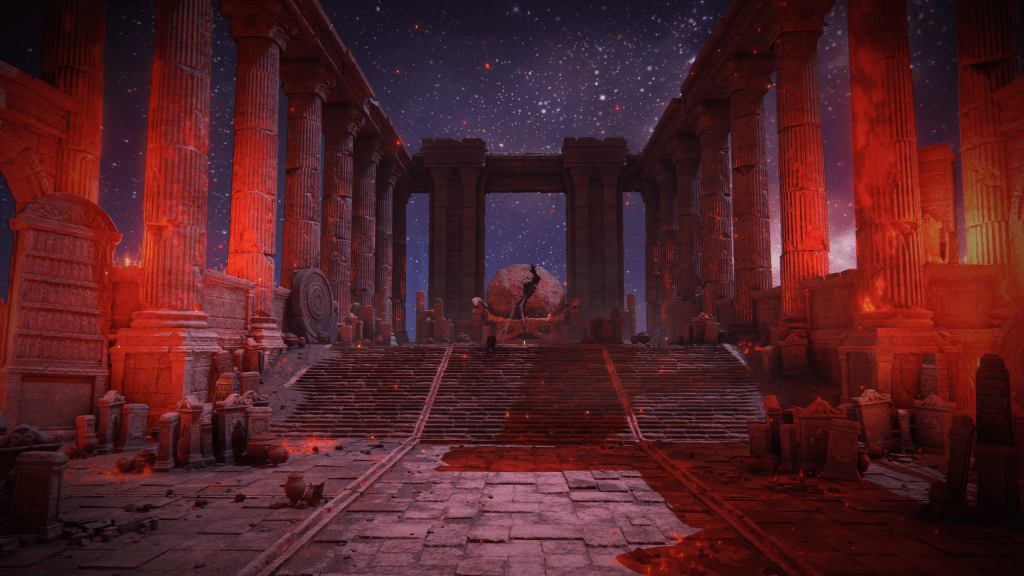
Anyway I bring all this up because Elden Ring’s Shadow of the Erdtree expansion is out and I am obsessed with it. I previewed it for PC PowerPlay and I’ve been mainlining it all weekend. I think I’m ahead of Brando Sando. I don’t yet know how Timothy Zahn is doing at it. I assume George RR Martin, having written the lore for the game (or at least some of it), is not playing.
But it got me thinking about other media that does this sort of thing. On The GAP, my co-host Luke Lawrie long ago pitched the idea that he doesn’t watch trailers for films any more, and he thinks his experience is better for it. I adopted the habit, and he’s right. At the time, the idea behind it had more to do with the fact that movie trailers were injecting more and more critical plot information into their two minute previews, but going into a film blind is a sort of Explorer experience, really. Because as the film unfolds, the viewer experiences a sense of discovery. One not tainted by previews, by scenes already seen.
And there are so many other ways to experience a sense of discovery.
Something I love in books is when they encourage me to research more. To find out more details elsewhere. Michael Crichton was a master of this, in my opinion, seeding his popular fiction with titbits of (usually shoddily researched) information that would have me sprinting to the local library to find out more about weird neurotoxins and DNA and whether Crichton had a sponsorship deal with Gore-Tex.
Tom Clancy did something similar, but half the time he’d do the research for you, and then weave it into the narrative the way a hand is weaved into a pocket.
Obviously I preferred Crichton’s method, and it’s still something I love to this day. I think it’s what appeals to me about books by Peter Clines and Peter Watts and other authors not named Peter. Mike Mignola isn’t just imbuing his stories with existential threats and christian mythology, each new story includes something I can’t help but google to investigate further.
And what makes all of these writers great is that you don’t need to do any extra reading to understand their stories. But if you’d like to chase the rabbit of discovery, you can, and a lot of these books give ample opportunity to do just that.
Obviously this all stems from my own desire to do research all the time. There aren’t many authors who hate research—many like it too much. I am definitely one. So when a book gives me an excuse to do research, I relish it. It’s harder with films, because so often you remain so utterly engaged with the movie that you can’t jot down a note about something you’d like to look up later. But I love it when TV Shows do it too.
It’s something I try to put into my writing as well. Not just my fiction—I love seeding odd little non-sequiturs into my games writing that hopefully pique a reader’s interest, when the word count will allow.
But it’s something I actively chase in my fiction. I want people to look up more on the pre-fab-hab structure described in Do Not Kill Joab Gilroy. Those are based on real life plans for liveable areas on trips to Mars—if they can solve the kidney stone problem.
Blackbirded is chock full of stuff I think people should find out more about. Stuff I wasn’t taught in school, and found fascinating when I read about it later in life. And it’s hopefully written in a way that makes people want to—but not have to.
My next project involves more of it. I don’t know if I know “the trick” to doing it yet, because I’m not what you would call a successful author, but my strategy is to research the shit out of stuff and then remove as much of that research as possible. And sure, to the untrained eye it just looks like procrastination disguised as research, but if I get through to just one person, it’ll all be worth it. Particularly if that person happens to pay $46,000 for my book.
If you see PC PowerPlay #304 on a shelf in your nearby Newsagent, grab it! I wrote the cover feature. The design team did a cracking job with the story within too, it looks fantastic.
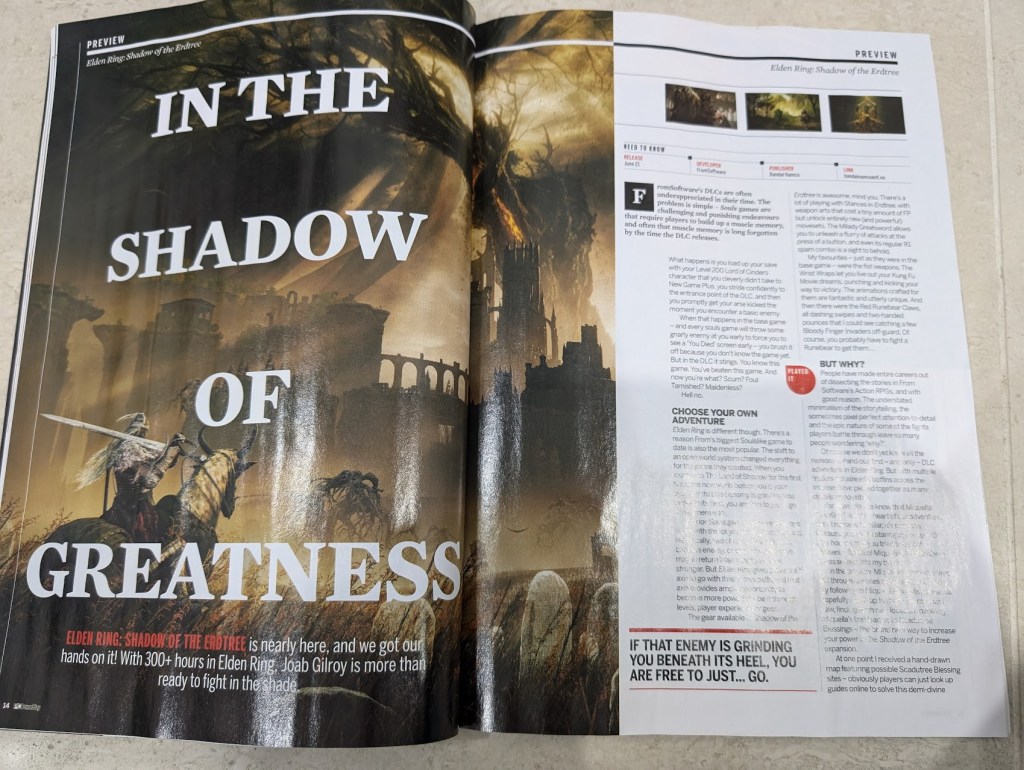
Gaming-wise I’ve been playing Elden Ring Shadow of the Erdtree. Few games hit me like Souls games do any more. I think on launch Erdtree might be a little bit harder than it should be, the Scadutree Blessings seem to do between nothing and sweet fuck-all, but I’m loving the exploration aspect and it’s oh-so satisfying when I finally beat a boss.
I’ve been reading Dan Simmons’ The Terror and it’s exactly my kind of book so far. Although I’ve found the shift in tense difficult to parse, I have a feeling it is intentional, and I’m hoping it can stick the landing.
Writing-wise, I have nothing really to say. Editing is complex, new projects equally so. I wish I could hit you with a progress bar that details how far along either is but it’d be pure Windows time shit and I’d rather not. I’ll tell you more when I have more to tell.
*A “Souls player” is someone who plays Souls games*.
** This Dark Souls 3 Review on AusGamers, like this blog post, is not the first time I used the Tourists and Explorers analogy.
*A Souls game is any game from the Dark or Demons Souls series. At this point, it’s also any game from series creator FROM Software* that bears similarities to those games. So you have Demons Souls, Dark Souls, Dark Souls 2, Bloodborne, Dark Souls 3, Sekiro and Elden Ring.
*If a game bears those similarities but does not come from FROM Software, it is called a Souls-like*, or a Souls-lite** depending on the similarities.
*Souls-likes* include Lies of P, Nioh, Lords of the Fallen, Remnant and more.
**Souls-lites* include Assassin’s Creed Valhalla, Jedi: Survivor and a third one I can’t think of but should include because of the rule of threes.
*To the disdain of all, I insist on tarring all games* falling under the banner of Souls-likes and Souls-lites with the one Souls-litke brush. Mostly because the distinctions between lite and like are usually meaningless and almost always incorrect, and to avoid becoming an insufferable prescriptivist I defer to absurdity.
*I guess I should explain what makes a game a Souls game? There is really only one characteristic that is wholly unique to the Souls game. You gain Souls (or Runes or XP) and when you die, you lose those gains. Sometimes you can recover them*, but they are vulnerable until you bank them by levelling up. Outside of this, Souls games are generally Metroidvania-style** affairs played in the third person perspective characterised by challenging enemies, existential horror themes and minimalist storytelling.
*In all cases except one, Sekiro.
**Metroidvania games feature large maps players can traverse however they please. Backtracking is usually necessary as players unlock new abilities as they play which make traversing the map easier. The name is derived from the Metroid and Castlevania series.
***I’m publishing a few days late for Bourdain Day, unfortunately, but the message is worth remembering every day. More people have entertained suicidal thoughts than you probably think. Those thoughts pass. Lifeline Australia’s number is 13 11 14 if you need help.
 Joabyjojo
Leave a comment